Ваши коллеги ответили:
Delayed cystoscopy
Continue follow-up with cytology alone, without hospital visits
Urinary biomarker test now and, if negative, cystoscopy in 3 months; if positive, expedite the cystoscopy
your answer
This language version is in progress; translations will be added gradually.
David is a 71-year-old amateur golfer. Despite the closing of the golf club due to the COVID-19 pandemic, he enjoys playing a game in his 8 square meter garden using a miniature golf set.
He was diagnosed with non-muscle-invasive bladder cancer (NMIBC) 3.5 years ago. Control cystoscopy 18 months ago showed again a papillary tumour. He underwent TURBT and re-TURBT.
Since his last follow-up 3 months ago, healthcare systems are overloaded due to the COVID-19 pandemic. The patient cannot visit the hospital due to cancelation of appointments. His next appointment can be scheduled the earliest in 2 months, which is 5 months from his last cystoscopy.
However, the urologist is concerned and the patient is anxious about delayed follow-up.
Delayed cystoscopy
Continue follow-up with cytology alone, without hospital visits
Urinary biomarker test now and, if negative, cystoscopy in 3 months; if positive, expedite the cystoscopy
Delayed cystoscopy
Continue follow-up with cytology alone, without hospital visits
Urinary biomarker test now and, if negative, cystoscopy in 3 months; if positive, expedite the cystoscopy

The urologist is concerned and the patient is anxious about delayed follow-up, because this patient is at high risk of recurrence and progression according to the European Association of Urology (EAU) guidelines [1].
The follow-up of patients with non-muscle-invasive bladder cancer (NMIBC) is crucial to ensure early detection and prompt treatment of high-grade disease recurrence. For high-risk patients, the EAU guidelines recommend cystoscopy and urinary cytology at 3 months. If negative, cystoscopy and cytology should be repeated every 3 months for a period of 2 years, and every 6 months thereafter until 5 years, and then yearly [1].
Unfortunately, the ongoing COVID-19 pandemic has huge impact for NMIBC patients, as outpatient procedures such as cystoscopy may be delayed due to COVID-19 regulations. We have to adapt our clinical practice as quickly and efficiently as possible.
The options available in this situation are:
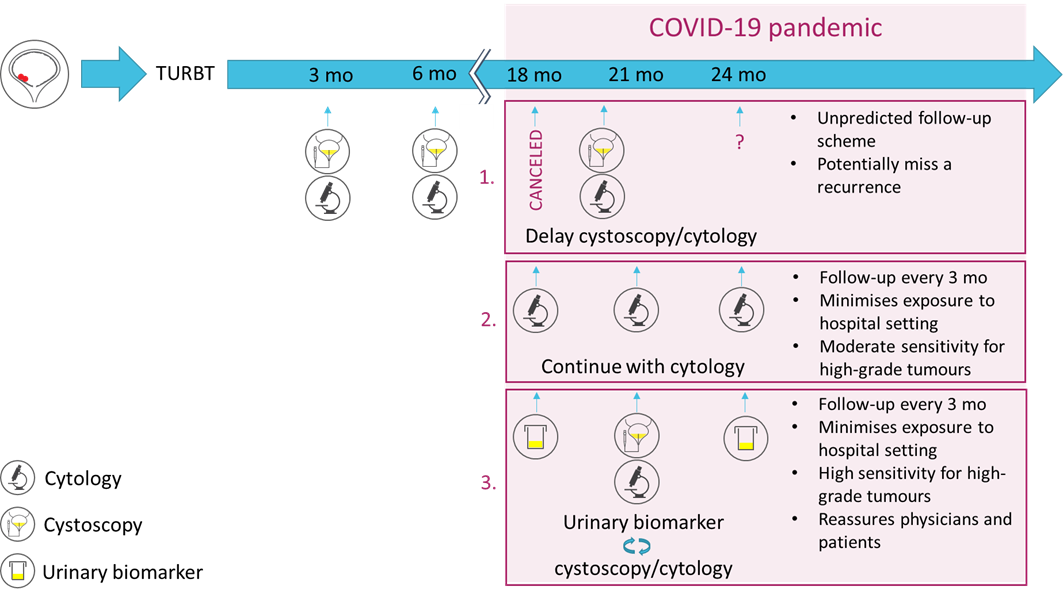
Delaying the routine follow-up schedules of bladder cancer patients, greatly increases the risk of leaving tumour recurrences undetected. For patients, this can mean the difference between early treatment and disease progression.
Continue follow-up with cytology alone would mean no hospital visits but is inappropriate because of its low sensitivity. Almost half of high-grade tumours are missed with cytology [2].
In my opinion, alternating a urinary biomarker with cystoscopy and cytology for bladder cancer surveillance should be explored, especially during the COVID-19 pandemic. With the unpredictable evolution of the pandemic, one can only guess how frequent follow-up appointments can be scheduled.
The selected urine biomarker should have high sensitivity for high-grade disease to ensure high-grade recurrences are not missed. The specificity of the test should also be high, to avoid unnecessary cystoscopies in patients with a positive test result but no recurrence.
Using such a urinary biomarker in this situation has 3 major advantages:
For patients such as David, urinary biomarkers can make the difference between early and late diagnosis and we should use them to monitor our bladder cancer patients from a safe distance.