
The urologist is concerned and the patient is anxious about delayed follow-up, because this patient is at high risk of recurrence and progression according to the European Association of Urology (EAU) guidelines [1].
The follow-up of patients with non-muscle-invasive bladder cancer (NMIBC) is crucial to ensure early detection and prompt treatment of high-grade disease recurrence. For high-risk patients, the EAU guidelines recommend cystoscopy and urinary cytology at 3 months. If negative, cystoscopy and cytology should be repeated every 3 months for a period of 2 years, and every 6 months thereafter until 5 years, and then yearly [1].
Unfortunately, the ongoing COVID-19 pandemic has huge impact for NMIBC patients, as outpatient procedures such as cystoscopy may be delayed due to COVID-19 regulations. We have to adapt our clinical practice as quickly and efficiently as possible.
The options available in this situation are:
- Delayed cystoscopy and cytology
- Continue follow-up with cytology alone
- Alternating a urinary biomarker with cystoscopy and cytology
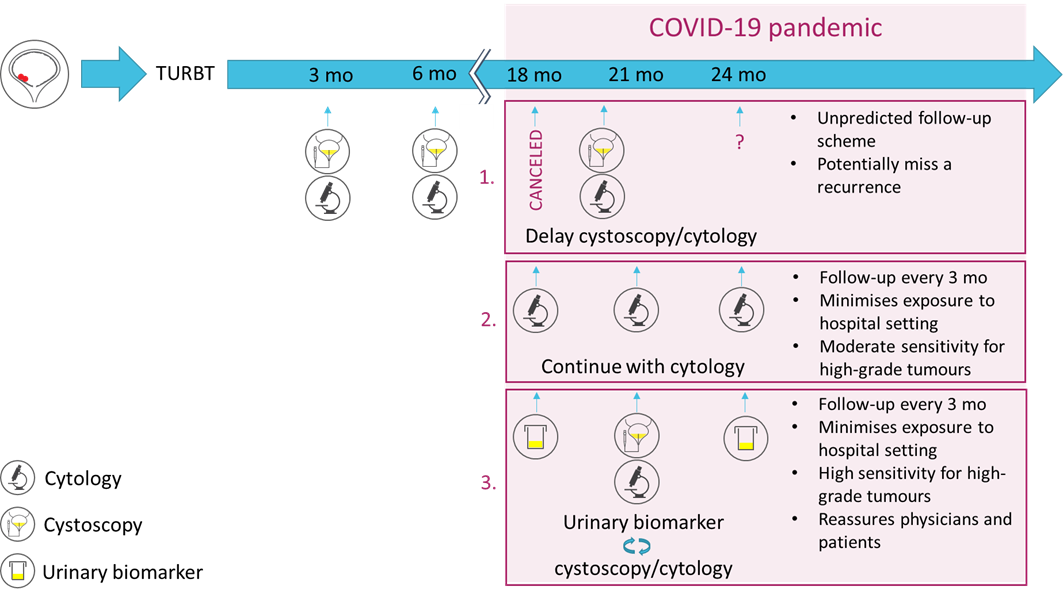
Delaying the routine follow-up schedules of bladder cancer patients, greatly increases the risk of leaving tumour recurrences undetected. For patients, this can mean the difference between early treatment and disease progression.
Continue follow-up with cytology alone would mean no hospital visits but is inappropriate because of its low sensitivity. Almost half of high-grade tumours are missed with cytology [2].
In my opinion, alternating a urinary biomarker with cystoscopy and cytology for bladder cancer surveillance should be explored, especially during the COVID-19 pandemic. With the unpredictable evolution of the pandemic, one can only guess how frequent follow-up appointments can be scheduled.
The selected urine biomarker should have high sensitivity for high-grade disease to ensure high-grade recurrences are not missed. The specificity of the test should also be high, to avoid unnecessary cystoscopies in patients with a positive test result but no recurrence.
Using such a urinary biomarker in this situation has 3 major advantages:
- It helps to detect a recurrence that would otherwise be missed because of delayed cystoscopy.
- It provides reassurance to the physician and the patient that no high-grade disease is missed.
- It allows to prioritise and properly select patients for the limited cystoscopy slots.
- Minimises exposure of a potentially vulnerable patient to the hospital setting. The urine sample can simply be collected from the patient’s home or a community location nearby.
For patients such as David, urinary biomarkers can make the difference between early and late diagnosis and we should use them to monitor our bladder cancer patients from a safe distance.